Showing posts with label Cardiovascular System. Show all posts

Body Systems: Cardiovascular System: Components of Blood

This is a fun way to review the parts that make up blood.

Plasma
Makes up 55% of your blood.  It's a thick liquid that carries that transports food and waste.

Fill a clear glass/jar/beaker 55% full with corn syrup.

Red Blood Cells
Make up 44% of your blood (by volume).  These cells carry oxygen and carbon dioxide throughout your body.

Add candy red hots to the corn syrup, until the container is nearly full.

White Blood Cells
These cells are significantly larger than red blood cells, and there are far, far fewer of them in your blood.  These cells clean-up old blood cells and fight the germs that enter your body.

Add a few mini-marshmallows or white jelly beans to your concoction.

Platelets
These are tiny fragments of cells (some books will just refer to them as cells) are responsible for forming clots when you are cut.

Shake some non-pareils into your blood model.


You now have a cup of "blood".  You'll notice that much of it is liquid, but there's lots of solid in it as well.  You'll also notice lots of red blood cells with the occasional white blood cell popping up.  You have to look really hard to see the platelets - both because of their small size and because of their small numbers. 

Body Systems: Cardiovascular System: Heart Diagram Roundup

All last week I shared some heart themed science activities.  In case you missed them, they were:
Beat Your Heart
Race Your Heart
Heart Squeeze
Heart Mambo
Heart Mold

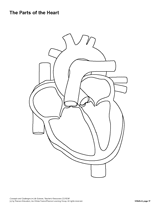
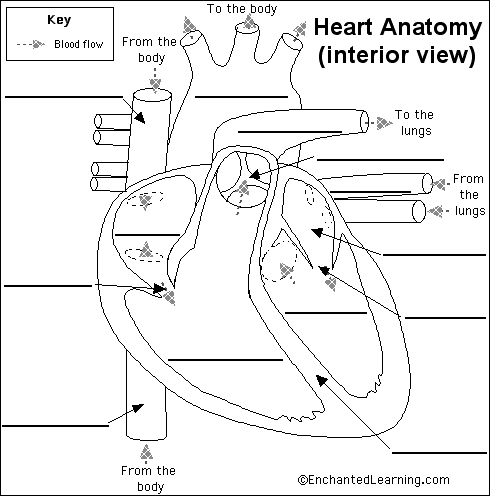
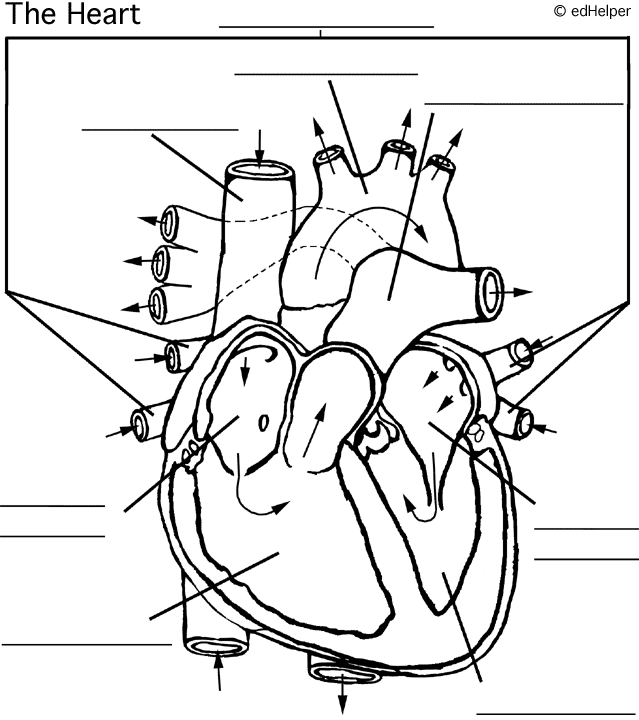
And for today, I'll leave you with some printable heart diagrams.  Happy Valentine's Day!

You can find a plethora of heart diagrams on the Internet.  Here are several different ones - some with spots to label, some plain, and some in color.  To get the full-size image, click on the word link. 

From TeacherVision:


The Science Museum of Minnesota: (they also have some interesting animations here)


From edHelper (with labels here):


From Wikipedia:

Body Systems: Cardiovascular System: Heart Mold

It's probably too late to use this idea for this year, but it's always okay to start planning for next year. 

Educational Innovations (more on them coming up in the near future) makes this heart mold to be used in constructing a gelatin heart.  It includes instructions for making a hear the same size, shape, mass and color as an adult human heart. 

A little disturbing, a lot cool!


PS If you like this sort of thing, they also make a brain mold...

PPS Amazon sells a similar heart mold and brain mold.  They are less expensive, but I'm not sure how the size compares and I don't believe they include the instructions for getting the proper mass and color.

Body Systems: Cardiovascular System: Heart Mambo

You'll need to do a bit of prep work on this one, but it's a great learning tool, especially for your kinesthetic learners.

This activity originally comes from Janet Guadino and was shared at the 2007 Maitland Simmons Life Science Institute.


You'll need to make a series of signs for the floor. Use as many 'parts' as is appropriate for your students.  I've chose not to include the valves, but they are included in the list, parenthetically.

Blue Signs (written in blue or on blue paper)
Right Atrium
Right Ventricle
(Tricuspid A.V. Valve)
(Pulmonary Semilunar Valve)
Pulmonary Trunk Artery
Veins
Veins
Vena Cava
Arrow (x12)

Red Signs (Written in red or on red paper)
Pulmonary Vein
Left Atrium
Left Ventricle
(Aortic Semilunar Valve) 
(Bicuspid/Mitral A.V. Valve)
Aorta
Arteries
Arteries
Arrow (x9)


Red and Blue Signs
Capillaries
Capillaries

Neutral Colored
Lungs

Arrange the cards on the floor as shown below (this is a condensed view, so they'll fit in one picture; you'll obviously want them spread apart so the path can be walked along):


In case you can't make it out from those shadowy pictures, the order of the signs is...

Lungs/Capillaries
Pulmonary Vein
Left Atrium
Left Ventricle
Aorta
Arteries
Capillaries
Veins
Vena Cava
Right Atrium
Right Ventricle
Pulmonary Artery
And back to the lungs


Have the students form a conga line behind you and lead them through the heart.  As you're traveling, chant "We're goin' through the heart, yeah!" Feel free to add some conga motions as well.  Pause at each location and call out where you're at/what you're doing. 

To close out the activity, have students place the following steps in order.  There is no right or wrong step to begin with, as it's a cycle, it's the order in which they appear that matters.  (I've written them in order for you, but you'd obviously mix them up before handing them to your students):

1 - Oxygen poor blood flows from the body into the right atrium

2 - The blood flows from the right atrium to the right ventricle

3 - The right ventricle pumps blood into the arteries that lead to the lungs

4 - In the lungs the blood picks up the oxygen and leaves carbon dioxide

5 - Oxygen rich blood leaves the lungs and enters the left atrium

6 - Blood flows from the left atrium into the left ventricle

7 - oxygen rich blood leaves the left ventricle and enters the aorta

8 - The aorta carries the oxygen rich blood to the rest of the body

Body Systems: Cardiovascular System: Beat Your Heart

How much work does your heart really do?  The numbers are quite staggering... figure them out for yourself.


Part I: How many heartbeats in your lifetime?
Determine your pulse: count the number of beats in 15 seconds.

Multiply by 4 to get the number of beats her minute.  (Average is between 70 and 90).

Now, use that number to determine how many times your heart will beat, assuming an average lifespan of 78 years.


Part II: How Much Blood?
1/4 cup (2 oz.) of blood is pumped per contraction.  Using the number of beats per minute you calculated above, determine how much blood is pumped in one minute.  (Average is 20 cups = 5 quarts).

How many quarts of blood are pumped in a day?

How many gallons are pumped in a day?

Remember: 4 cups = 1 quart; 4 quarts = 1 gallon


Part III: How Much Does Your Blood Weigh?
About 10% of your weight is blood.

How many pounds of blood are in your body?